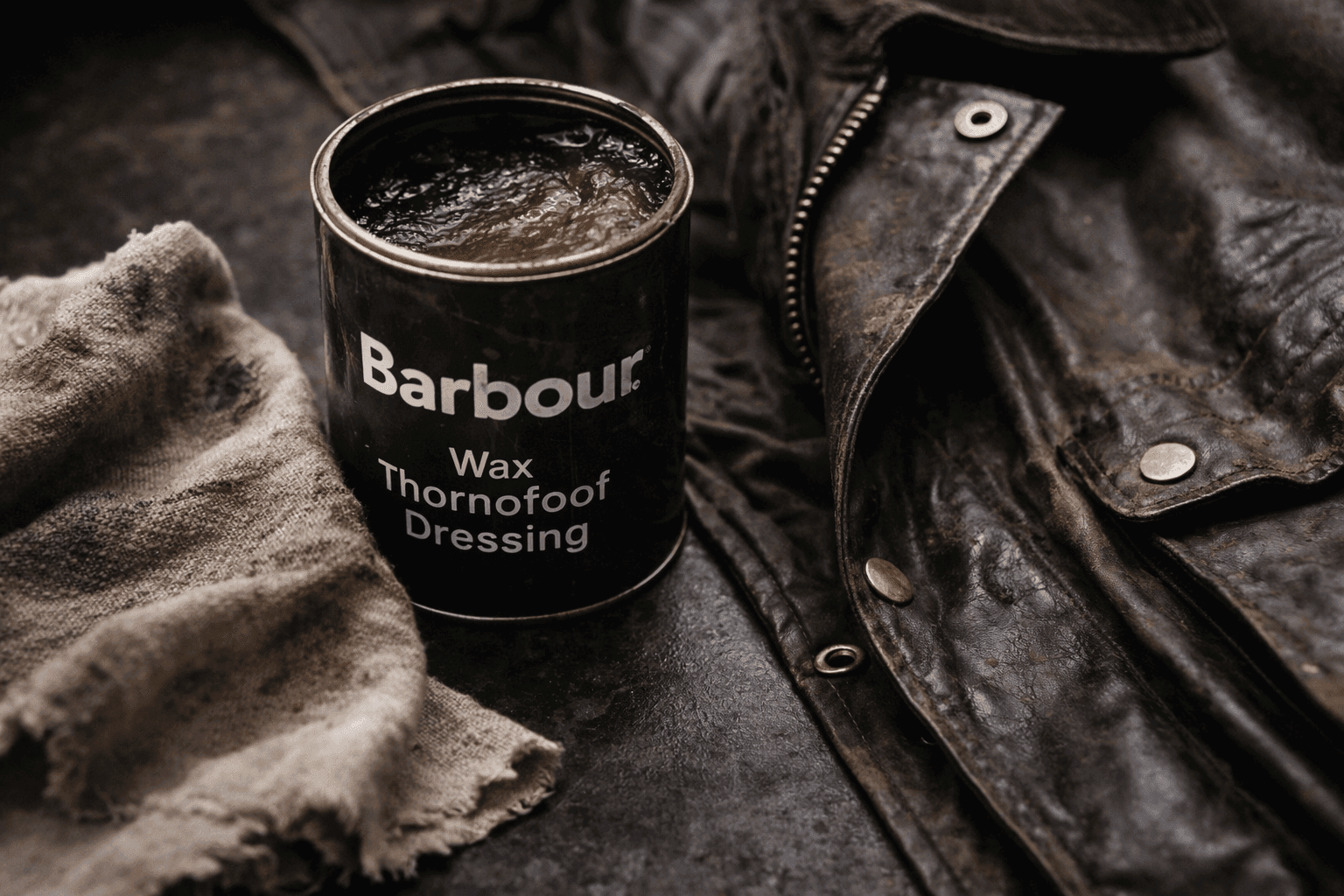
Your Barbour jacket cost £279-399 and it's letting rain straight through. The jacket isn't broken—the wax coating that makes Barbour jackets waterproof wears off over time, typically after 12-18 months of regular wear. The solution is reproofing: reapplying wax to restore water resistance. Flash Fashion Club, a UK-based luxury fashion alerting service, monitors Barbour alongside 28 other heritage brands—but some things matter more than sale prices. Maintaining the Barbour you own costs less than replacing it.
Why Barbour Jackets Stop Being Waterproof
Barbour's waxed cotton jackets achieve water resistance through a coating of wax (traditionally a blend of paraffin, beeswax, and other oils) applied to Egyptian cotton. When new, this coating causes water to bead and roll off the fabric surface.
What happens over time:
The wax coating degrades through normal use:
- Abrasion: Bag straps, seatbelts, and movement wear wax from high-friction areas
- Absorption: The wax slowly absorbs into the cotton fibres and dissipates
- Temperature: Heat (car seats, radiators, direct sunlight) melts and redistributes wax unevenly
- Cleaning: Improper washing strips wax entirely
The visible signs:
| Sign | What It Means | Urgency | |------|---------------|---------| | Water no longer beads | Surface wax depleted | Reproof soon | | Fabric appears dry/faded | Wax significantly worn | Reproof now | | Light patches at elbows/shoulders | High-wear areas depleted | Reproof now | | Fabric feels stiff and dry | Wax completely gone | Reproof immediately | | Water soaking through | No water resistance remains | Reproof immediately |
The timeline:
- Light use (occasional weekends): Reproof every 2-3 years
- Regular use (weekly wear): Reproof every 12-18 months
- Heavy use (daily outdoor wear): Reproof every 6-12 months
Most owners fall into the "regular use" category and should expect to reproof annually or biannually.
The Two Reproofing Options
You have two choices for restoring your Barbour's water resistance:
Option 1: DIY Reproofing (£20-25)
What you need:
- Barbour Thornproof Dressing (£20 for 200ml tin—enough for 2-3 applications)
- Clean, lint-free cloths
- Hairdryer or heat gun
- Well-ventilated workspace
- 2-3 hours of time
Best for:
- Regular maintenance between professional services
- Those comfortable with hands-on garment care
- Budget-conscious owners
- Maintaining specific high-wear areas
Option 2: Barbour Professional Reproofing (£40-50)
What you get:
- Complete wax stripping and reapplication
- Professional-grade wax application
- Repair assessment (minor repairs often included)
- Quality guarantee
- 4-6 week turnaround
Best for:
- Jackets that haven't been reproofed in 3+ years
- Heavily worn jackets needing restoration
- Those wanting guaranteed results
- First-time reproofing (to see proper technique)
The honest assessment:
DIY reproofing works well for maintenance but rarely matches professional results. Barbour's service costs 2x DIY materials but delivers noticeably better, more even coverage. The ideal approach: professional reproofing every 2-3 years, DIY touch-ups in between.
DIY Reproofing: Step-by-Step Guide
Before You Start
Gather materials:
- Barbour Thornproof Dressing (the official product—alternatives exist but Barbour's formula is optimised for their cotton)
- Clean, lint-free cloths (old t-shirts work well)
- Hairdryer (or heat gun on low setting)
- Newspaper or drop cloth for workspace
- Warm room (wax applies better in warmth)
Prepare the jacket:
- Remove all items from pockets
- Brush off loose dirt with a soft brush
- Wipe down with a damp cloth to remove surface grime
- Allow to dry completely (overnight if necessary)
- Hang in a warm room for 1-2 hours before starting
Important: Never machine wash a waxed Barbour. Water and detergent strip wax completely. If your jacket is genuinely dirty (mud, significant staining), sponge clean with cold water only and allow to dry naturally.
The Reproofing Process
Step 1: Warm the wax
Place the unopened tin of Thornproof Dressing in a bowl of hot water for 10-15 minutes. The wax should become soft and spreadable—approximately the consistency of soft butter. If it's still firm, continue warming.
Why this matters: Cold wax doesn't spread evenly and leaves thick patches. Properly warmed wax flows into the cotton weave.
Step 2: Apply to high-wear areas first
Using a clean cloth, apply wax to the areas that wear fastest:
- Shoulders (bag straps, rain impact)
- Elbows (constant flexing)
- Cuffs (abrasion)
- Pocket edges (hand entry)
- Front closure area (zip/button friction)
Apply in circular motions, working the wax into the fabric. Use moderate pressure—you want the wax to penetrate, not sit on the surface.
Quantity guide: A 200ml tin should cover one complete jacket with some remaining. If you're using significantly more, you're applying too thickly.
Step 3: Apply to remaining areas
Work systematically across the jacket:
- Back panel
- Front panels
- Sleeves
- Under collar
- Storm flaps and pocket flaps
Ensure complete coverage but avoid thick buildup. The goal is a thin, even coating across all surfaces.
Step 4: Heat treatment
This step makes the difference between adequate and excellent reproofing.
Using a hairdryer on medium heat, warm each section of the jacket systematically. Hold the dryer 6-8 inches from the fabric and move continuously—never concentrate heat in one spot.
What you're looking for: The wax will visibly melt and absorb into the fabric, changing from a surface coating to an integrated treatment. The fabric should darken slightly and develop an even, slightly glossy appearance.
Time required: 15-20 minutes for complete heat treatment.
Step 5: Address any missed spots
After heat treatment, inspect the jacket under good light. Look for:
- Light patches where wax didn't penetrate
- Uneven areas where coverage varies
- High-wear zones that may need additional application
Apply additional wax to any problem areas and heat-treat again.
Step 6: Final curing
Hang the jacket in a warm, well-ventilated area for 24 hours before wearing. This allows:
- Complete absorption of wax into fibres
- Even distribution throughout the fabric
- Any excess wax to be absorbed rather than transferring to clothing
Step 7: Test
After curing, test water resistance by dripping water onto the fabric. Water should bead and roll off. If water absorbs, additional wax is needed in that area.
Common DIY Mistakes
| Mistake | Result | Solution | |---------|--------|----------| | Applying cold wax | Uneven coverage, thick patches | Always warm wax first | | Skipping heat treatment | Wax sits on surface, transfers to clothes | Always heat-treat after application | | Over-applying | Sticky finish, wax transfer | Use thin, even coats | | Under-applying | Incomplete water resistance | Multiple thin coats beat one thick coat | | Not allowing cure time | Wax transfers to clothing | Wait 24 hours before wearing |
Professional Reproofing: What to Expect
Barbour offers professional reproofing through their website and selected retailers:
The Service
What's included (£40-50):
- Complete inspection of jacket condition
- Removal of old, degraded wax
- Professional reapplication of Barbour wax
- Treatment of all areas including hard-to-reach sections
- Quality check before return
Optional extras:
- Repairs to tears, worn areas, or damaged components (quoted individually)
- Re-lining (for significantly worn jackets)
- Hardware replacement (zips, studs, buttons)
How to Access
Option 1: Barbour directly
- Ship jacket to Barbour's South Shields factory
- Order service through barbour.com
- 4-6 week typical turnaround
- Jacket returned via tracked delivery
Option 2: Authorised retailers
- Some Barbour stockists accept jackets for reproofing
- They ship to Barbour on your behalf
- Potentially faster if local retailer has regular shipments
Option 3: Barbour stores
- Flagship stores accept jackets in person
- Same service, same turnaround
- Opportunity to discuss any repairs needed
When to Choose Professional
Choose professional reproofing when:
- Jacket hasn't been reproofed in 3+ years
- Wax is completely depleted across most of the jacket
- You want repairs assessed simultaneously
- You've never reproofed before (see proper results first)
- The jacket has significant value (limited editions, vintage)
Choose DIY when:
- Maintaining between professional services
- Only specific areas need attention
- Budget is constrained
- You're comfortable with the process
The Professional Difference
Having experienced both approaches, the professional service delivers noticeably better results:
| Factor | DIY | Professional | |--------|-----|--------------| | Coverage evenness | Good | Excellent | | Wax penetration | Moderate | Deep | | Longevity | 12-18 months | 18-24 months | | Finish quality | Variable | Consistent | | Time investment | 2-3 hours | None (ship and wait) | | Cost | £20-25 | £40-50 |
The professional service costs 2x but delivers approximately 1.5x the longevity—making the value comparable. For annual maintenance, DIY works well. For periodic restoration, professional service justifies the premium.
Reproofing Frequency: A Realistic Schedule
The Recommended Approach
Year 1: New jacket—no reproofing needed Year 2: DIY touch-up of high-wear areas (shoulders, elbows, cuffs) Year 3: Professional reproofing (full restoration) Year 4: DIY touch-up Year 5: Professional reproofing Continue alternating...
This approach costs approximately £35/year averaged across the cycle while maintaining optimal water resistance.
Adjusting for Your Usage
| Usage Pattern | DIY Frequency | Professional Frequency | |---------------|---------------|----------------------| | Occasional (monthly) | Every 3-4 years | Every 5-6 years | | Regular (weekly) | Every 12-18 months | Every 2-3 years | | Heavy (daily outdoor) | Every 6 months | Every 12-18 months | | Country/field sports | Every 6-12 months | Every 18-24 months |
Climate Considerations
Wet climates (Scotland, Wales, Northwest England) demand more frequent reproofing than dry climates. If you're regularly wearing your Barbour in rain, expect to reproof at the higher end of these ranges.
Beyond Reproofing: Complete Barbour Care
Reproofing is the most important maintenance, but complete Barbour care involves additional practices:
Regular Maintenance
After each wear:
- Hang on a wide, padded hanger (wire hangers distort shoulders)
- Allow to dry naturally if wet (never use direct heat)
- Brush off any mud or debris once dry
Monthly:
- Inspect for wear patterns developing
- Check hardware (zips, studs) for function
- Spot-clean any stains with cold water
Seasonally:
- Assess overall wax condition
- Touch up any depleted areas
- Check lining for wear
What Not to Do
Never machine wash: Water and detergent strip wax completely. Even "gentle" cycles damage waxed cotton.
Never dry clean: Dry cleaning solvents dissolve wax and damage the cotton.
Never tumble dry: Heat damages the cotton and melts wax unevenly.
Never iron: Direct heat melts wax and can damage the fabric.
Never store compressed: Folding or compressing for extended periods creates permanent creases that don't recover.
Never hang near heat: Radiators, fireplaces, and sunny windows melt and redistribute wax.
Proper Storage
Short-term (daily use):
- Hang on a quality hanger in a ventilated space
- Allow room—don't compress between other garments
- Avoid direct sunlight and heat sources
Long-term (off-season):
- Clean thoroughly before storage
- Reproof if needed before storing
- Hang in a breathable garment bag (not plastic)
- Store in a cool, dark, ventilated space
- Check periodically for moth damage
The Lifespan Reality: How Long Barbours Actually Last
With proper care—regular reproofing, appropriate storage, careful use—Barbour jackets routinely last 20-30 years. Some examples:
The typical lifespan:
| Care Level | Expected Lifespan | Condition at End | |------------|-------------------|------------------| | No maintenance | 5-8 years | Worn out, no water resistance | | DIY reproofing only | 15-20 years | Good condition, character developed | | Professional reproofing | 25-30+ years | Excellent condition, beautiful patina |
The economics:
| Approach | 20-Year Cost | Annual Cost | |----------|--------------|-------------| | Replace every 5 years (no care) | £1,196 (4 jackets × £299) | £60 | | DIY reproofing | £299 + £200 (10 × £20) = £499 | £25 | | Professional reproofing | £299 + £350 (7 × £50) = £649 | £32 |
Professional reproofing costs £7/year more than DIY but delivers better results and longer lifespan. Both approaches dramatically outperform replacement.
The character argument:
Beyond economics, properly maintained Barbour jackets develop character that new jackets cannot match. The wax develops patina. The cotton softens. The jacket moulds to your body. A 15-year-old, well-maintained Barbour often looks better than a new one—and tells a story.
Quilted Barbour Care: Different Requirements
Quilted Barbour jackets (Liddesdale, Heritage Liddesdale, Annandale) don't use waxed cotton and require different care:
What Quilted Jackets Need
The difference: Quilted Barbours use nylon or polyester outer shells with polyester fill—no wax coating involved. Water resistance comes from the synthetic fabric, not applied wax.
Cleaning:
- Machine washable on gentle cycle (check label)
- Use mild detergent, no fabric softener
- Air dry or tumble dry on low heat
- Avoid high heat which damages synthetic fill
Maintenance:
- No reproofing required or possible
- Check zip function regularly
- Inspect stitching for unravelling
- Replace if fill becomes lumpy or compressed
Quilted vs Waxed: Care Comparison
| Factor | Waxed | Quilted | |--------|-------|---------| | Waterproofing method | Wax coating | Synthetic fabric | | Reproofing needed | Yes (annually) | No | | Machine washable | Never | Yes (gentle) | | Lifespan | 20-30 years | 10-15 years | | Maintenance cost | £20-50/year | Minimal | | Character development | Significant | Limited |
Quilted Barbours offer easier care but shorter lifespans. Waxed Barbours require more maintenance but reward it with decades of service.
Frequently Asked Questions
How often should you reproof a Barbour jacket?
Reproof your Barbour when water no longer beads on the surface—typically every 12-18 months with regular (weekly) wear. Light use extends this to 2-3 years; heavy outdoor use shortens it to 6-12 months. High-wear areas (shoulders, elbows, cuffs) may need touch-ups between full reproofing. Watch for water absorption rather than beading as the key indicator.
Can you reproof a Barbour jacket yourself?
Yes—DIY reproofing using Barbour Thornproof Dressing (£20) is straightforward. Warm the wax in hot water, apply to a clean jacket with a cloth, then heat-treat with a hairdryer to melt wax into the fibres. Allow 24 hours to cure before wearing. DIY works well for maintenance; professional reproofing (£40-50) delivers superior results for jackets that haven't been treated in several years.
How do you clean a Barbour wax jacket?
Never machine wash or dry clean a waxed Barbour—both methods strip the wax completely. For regular cleaning, brush off dried mud and wipe with a cold, damp cloth. For stubborn stains, use cold water and gentle sponging. Allow to dry naturally away from direct heat. If the jacket needs deep cleaning, Barbour's professional service combines cleaning with reproofing.
Is Barbour reproofing service worth it?
Barbour's professional reproofing (£40-50) is worth it when jackets haven't been reproofed in 3+ years, wax is completely depleted, or you want repairs assessed. The service delivers more even coverage and deeper penetration than DIY, with results lasting 18-24 months versus 12-18 months for DIY. For annual maintenance, DIY touch-ups suffice; for periodic restoration, professional service justifies the premium.
Why is my Barbour jacket not waterproof?
The wax coating that makes Barbour jackets waterproof wears off through normal use—abrasion, heat exposure, and time all degrade the wax. Water stopping beading and beginning to absorb indicates wax depletion. The solution is reproofing: reapplying wax to restore water resistance. This is normal maintenance, not a defect—expect to reproof every 12-24 months depending on usage.
Keep Your Barbour Performing
Flash Fashion Club monitors Barbour alongside 29 premium UK heritage brands—but the best Barbour is often the one you already own. Proper reproofing costs £20-50 annually and extends jacket lifespan to 20-30 years.
For new Barbour purchases:
- Get alerts when Barbour hits 40%+ off (rare and valuable)
- Email notifications during March and September clearances
- Instant Telegram alerts for Premium members
- Add to your collection at intelligent prices
For those looking to add to their Barbour collection, Flash Fashion Club alerts when new and classic styles reach 40%+ discount thresholds—typically during March clearance and September end-of-summer sales.
Already a member? View your dashboard
Join 5,000+ members who understand that quality maintenance matters as much as quality purchasing.